ARTIST
“I am in a phase in my life where I am trying to connect with and develop relationships through the music around the globe, any where there are people that can benefit from the positive and universal power of the music. In a time where so much of the world is trying to divide us from one another, I believe this is of the highest importance.” - Ted Chubb
Trumpeter & Composer
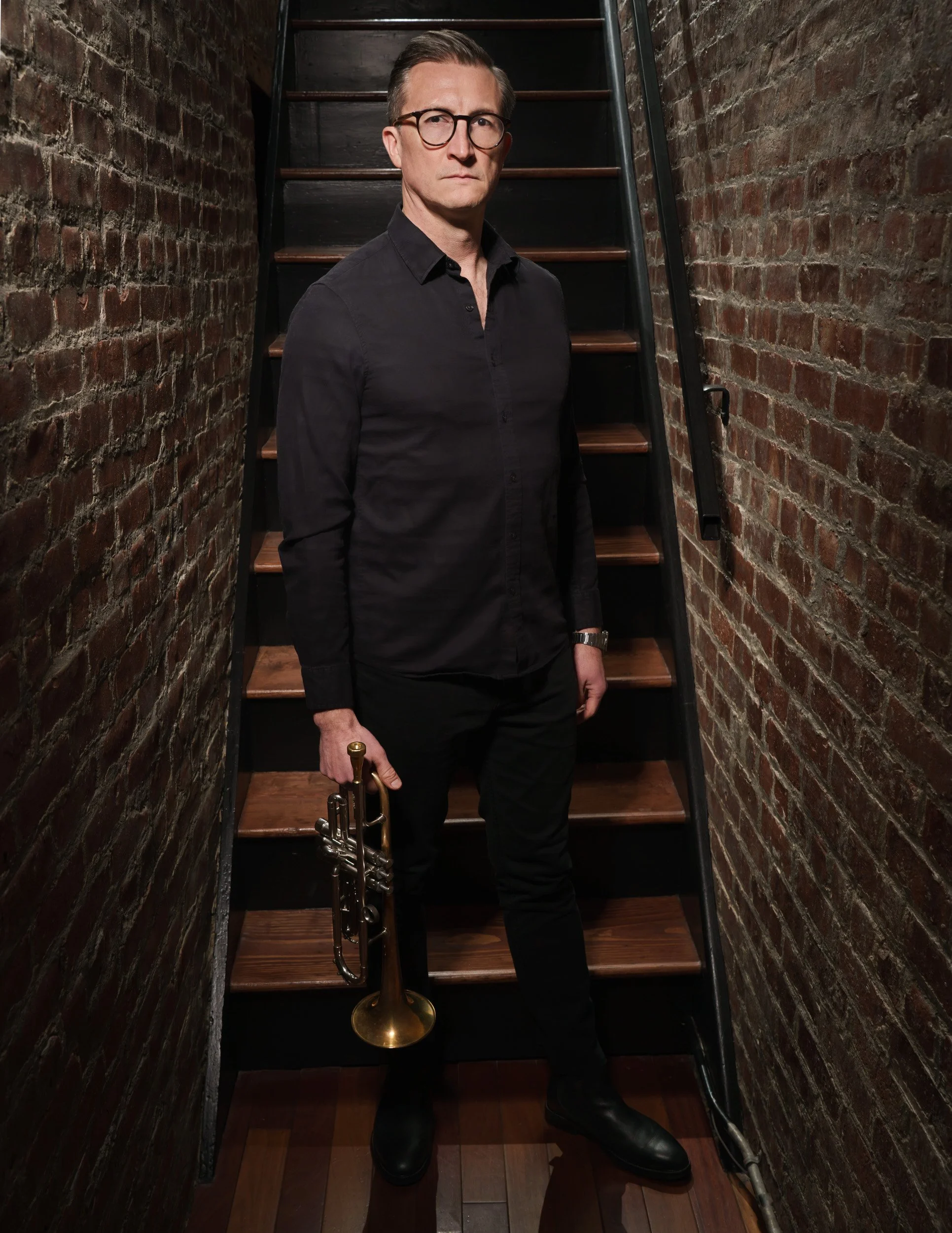
Born in Ashtabula, Ohio into a musical family, Chubb chose the trumpet at age ten. “For some reason the trumpet just felt like my voice,” he recalls. Hearing Miles Davis’s ’Round About Midnight and Lee Morgan with Art Blakey on A Night in Tunisia set his direction early. “I was completely enthralled from the moment I heard those records.”
Chubb’s playing centers on a warm, distinct trumpet sound grounded in storytelling and melody. His improvisations favor lyricism, direct melodic development, and conversational phrasing, drawing from the lineage of Miles Davis, Lee Morgan, Booker Little, Kenny Dorham, Freddie Hubbard, Blue Mitchell, Dizzy Gillespie, and Art Farmer while also absorbing the phrasing of vocalists such as Frank Sinatra, Sarah Vaughan, and Chet Baker. “Everything I play,” he has said, “I want to have the blues in it.” DownBeat praised his “warm, sinewy tone” and his ability to unravel “singable melodies.”
Chubb earned his Master of Music degree at Rutgers University, where he studied with trumpet pedagogue William B. Fielder, whose students include Wynton Marsalis, Terence Blanchard, Terrell Stafford, and Sean Jones. The phrase “Gratified Never Satisfied,” taught to him by Fielder, became both a personal credo and the title of his 2017 Unit Records release.
As a composer, Chubb favors melodies that remain singable and direct while leaving space for harmonic openness and rhythmic momentum. His pieces often grow from lived experiences — travel, family, community, and reflection — providing frameworks that encourage interaction and conversational improvisation among his collaborators.
As a leader, he first gained recognition with New Tricks, a chordless quartet that released New Tricks(2009) and Alternate Side (2011). He later released Gratified Never Satisfied (2017), featuring Bruce Williams, Seth Johnson, Oscar Perez, Tom DiCarlo, and Jerome Jennings.
As a performer, he has appeared alongside artists including Winard Harper, Christian McBride, Wallace Roney, and Rudresh Mahanthappa, and has shared stages with Billy Hart, Antonio Hart, Houston Person, Billy Harper, and George Coleman. From 2006 to 2011, he toured with the Tony Award–winning Broadway production Jersey Boys, performing more than 1,500 shows and appearing on national television. “No matter how you felt that day you had to produce,” he says. “You had to do your job.”
In May 2026, Chubb will release Live at The Statuary on Circle 9 Records, documenting his longstanding quintet with Williams, Perez, DiCarlo, and Jennings. Recorded over three nights in March 2025 inside the Jersey City space he co-owns and curates, the album captures a band shaped by decades of shared history and a musical approach rooted in clarity, lyricism, and collective exchange.
“Ted Chubb is a very talented trumpeter, composer, improviser, bandleader and educator. Ted is the total package, and most of all, he is just one great guy”
“Chubb led his agile sextet through infectious modern-bop originals, his warm, sinewy tone superbly unraveled singable melodies.”
“Ted Chubb is both brassy and elegiac, his crisp, fervent tone somewhat evoking Booker Little.””
“Chubb a keen thoughtful soloist, was evocative on “Blue and Green.” He mixed hard hitting ideas with those that were tender, each one a smart melodic package. With a soft to gritty sound Chubb offered both swinging and abstract leaning ideas.”
“One of my favorite trumpet players!”
“Playing against the bass and drums, Chubb blazed his own trail by improvising a series of song-like melodies.”